

Last updated: 9 November 2026
Vaping.news content is for adults aged 18 and over. Vaping products are for adult smokers. Nicotine is a highly addictive substance, and vaping is not risk-free.
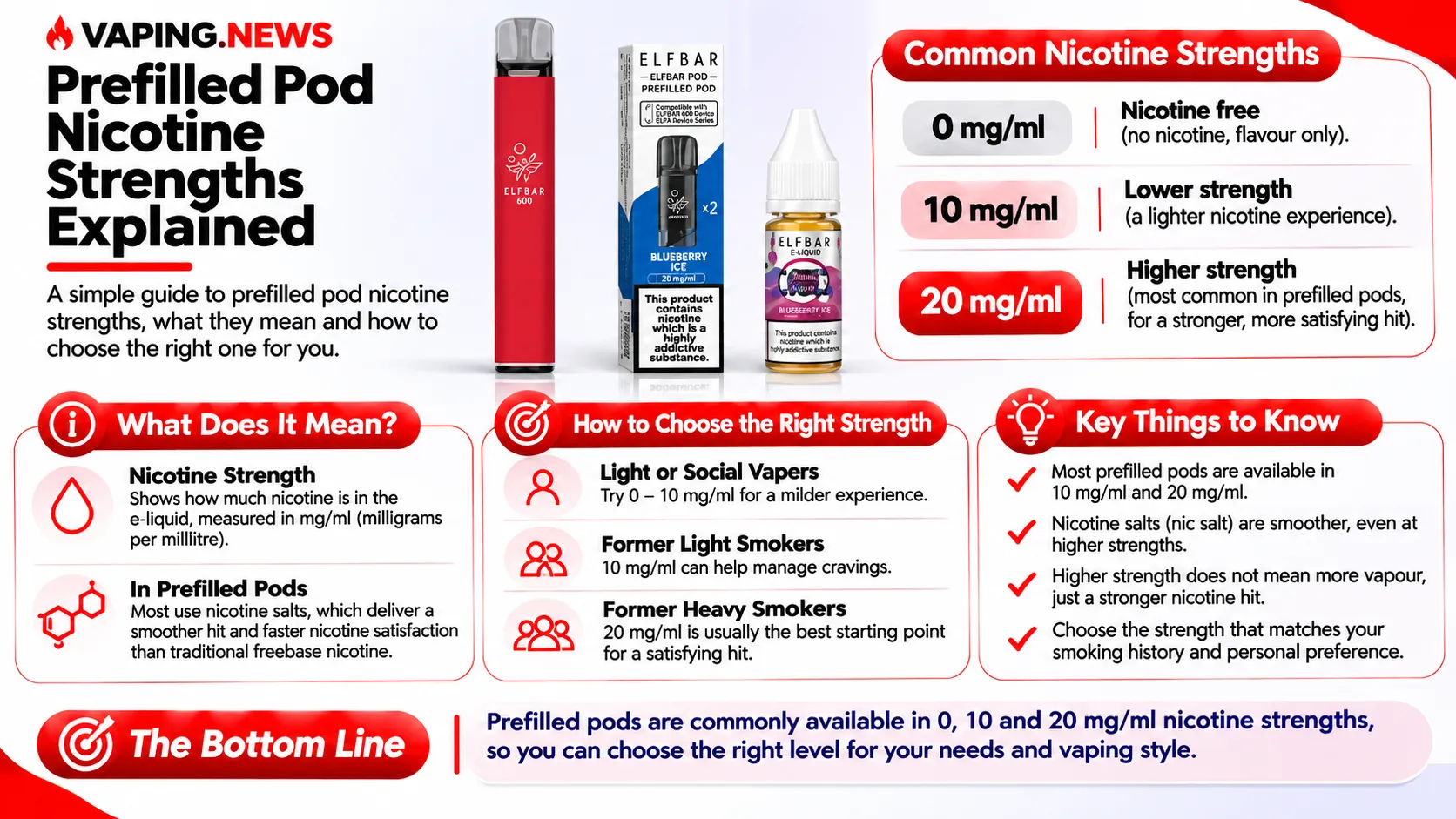
Prefilled pod nicotine strength is the amount of nicotine in each millilitre of e-liquid inside a sealed pod, shown in mg/ml or as a percentage. Many UK prefilled pods contain 20 mg/ml nicotine salt, the legal maximum, and a smaller number of ranges offer lower strengths such as 10 or 0 mg/ml in selected flavours. The sections below explain how strengths are labelled, which strengths exist, how nicotine salts differ from freebase nicotine, how to choose a strength as an adult smoker, how to step down over time, and the UK legal and duty rules that apply to every pod.
What Do mg/ml and Percentage Mean on a Pod?
Mg/ml means milligrams of nicotine in each millilitre of e-liquid. A percentage shows the same figure divided by 10, so 20 mg/ml equals 2% and 10 mg/ml equals 1%. The table below converts common strengths and shows the total nicotine in a 2 ml (0.07 fl oz) pod, the most a single pod can legally hold.
| Strength | Percentage | Total nicotine in a 2 ml pod |
|---|---|---|
| 20 mg/ml | 2% | 40 mg |
| 18 mg/ml | 1.8% | 36 mg |
| 12 mg/ml | 1.2% | 24 mg |
| 10 mg/ml | 1% | 20 mg |
| 6 mg/ml | 0.6% | 12 mg |
| 0 mg/ml | 0% | 0 mg |
Total nicotine in the pod is not the amount the body absorbs. Absorption depends on puff length, puff count, device power and how deeply the vapour is inhaled.
Which Nicotine Strengths Are Sold in UK Prefilled Pods?
UK prefilled pods are sold at any strength up to the 20 mg/ml legal limit, but most ranges concentrate on a few. Each band suits a different type of user:
- 20 mg/ml is a common strength across prefilled pod ranges, including the big puff kits that replaced disposables.
- Strengths between 10 and 20 mg/ml appear in some closed pod systems.
- Lower strengths appear in a smaller number of ranges built for step-down plans, often in selected flavours only.
- IVG, for example, states on its own site that it sells 10 mg and 0 mg IVG PRO 12 pods in selected flavours, alongside the original 20 mg pods.
- 0 mg/ml is less common, and few prefilled ranges offer it.
Flavour lists change often, so the strengths available in one flavour do not always match another flavour in the same range. Vaping.news has not tested these pods. The guide to zero-nicotine prefilled pod options covers the 0 mg/ml end of the market in detail.
Why Are Most Prefilled Pods 20 mg/ml?
Many prefilled pods are 20 mg/ml because the main buyers are adult smokers switching from cigarettes and former disposable users who were used to strong nicotine. A low-power mouth-to-lung pod produces modest vapour, so a higher nicotine concentration helps deliver enough nicotine to control cravings. The NHS says it is important to choose an e-liquid with enough nicotine to reduce withdrawal symptoms and urges to smoke. The page on prefilled pod kits explains how the devices, pods and batteries fit together.
Vapers who want strengths between 0 and 20 mg/ml in every flavour often move to a refillable pod kit. Bottled nicotine salt e-liquid is sold in bottles of no more than 10 ml (0.34 fl oz) at a range of strengths, which gives finer control over each step down. Refillable kits need coil changes and refilling, so they suit vapers who are comfortable with a little more maintenance than a sealed prefilled pod needs.
What Is Nicotine Salt and Why Do Pods Use It?
Nicotine salt is nicotine in e-liquid that contains an organic acid, such as benzoic acid or lactic acid, which lowers the pH of the e-liquid. The UK Committee on Toxicity (COT) reports that this form of nicotine is less harsh and bitter on inhalation and less irritating to the throat than freebase nicotine.
COT notes that pharmacokinetic studies generally showed higher or faster nicotine delivery from nicotine salt products, while stating that the evidence base is small and the effect cannot yet be quantified. Many UK prefilled pods use nicotine salt for these reasons. Read nicotine salts explained for the chemistry and the main acid types.
How Do Nicotine Salts Compare with Freebase Nicotine?
Nicotine salts are reported to feel smoother at high strengths and to deliver nicotine faster, while freebase nicotine gives a sharper throat hit and suits lower strengths and higher-power devices. The table below compares the two forms in general terms.
| Feature | Nicotine salt | Freebase nicotine |
|---|---|---|
| Usual strengths | Higher strengths, up to 20 mg/ml | Lower strengths in bottles, less common in prefilled pods |
| Throat feel | Less harsh, according to COT | Harsher |
| Speed of nicotine delivery | Generally higher or faster in studies reviewed by COT | Slower |
| Best device type | Low-power MTL pods | Higher-power tanks and kits |
Prefilled pod users meet freebase nicotine mainly when they move to bottled e-liquid. The page on freebase nicotine covers that format.
How Do You Choose a Nicotine Strength?
You choose a nicotine strength by matching it to how much you smoked and how strong your cravings are. The NHS says to start at a nicotine level that matches your cigarette use, meaning how frequently and how much you smoke. The guide below is general guidance, not a clinical rule:
- Heavier or frequent smokers: often start at a higher strength, such as 18 to 20 mg/ml.
- Lighter or occasional smokers: often start at a lower strength, such as 10 to 12 mg/ml.
- Cutting down after switching: step from 20 to 10 mg/ml, then lower.
- No longer using nicotine: choose 0 mg/ml or stop vaping.
Starting with less nicotine than your cravings need makes a return to cigarettes more likely, and signs of an underpowered strength include constant puffing, irritability and strong urges to smoke. The NHS lists headaches and mouth and throat irritation among vaping side effects, so drop a step if those appear. The full guide on how to choose nicotine strength when switching from smoking gives more detail.
A local Stop Smoking Service offers free help in England with strength and quitting plans, and a GP or pharmacist gives advice anywhere in the UK.
What Is the UK Legal Limit for Nicotine in Pods?
The UK legal limit is 20 mg/ml for nicotine-containing e-liquid under regulation 36 of the Tobacco and Related Products Regulations 2016. The same regulation caps single-use cartridges and tanks at 2 ml (0.07 fl oz) and refill containers at 10 ml (0.34 fl oz), and requires child-resistant and tamper-evident packaging.
Every nicotine product must be notified to and published by the MHRA before it can be sold.
Under regulation 37, packs need a leaflet, the nicotine health warning and a list of ingredients, nicotine content and batch number. Pods labelled above 20 mg/ml are illegal in the UK and are a strong sign of illicit stock.
Report suspected illegal pods to your local Trading Standards office. The overview of UK e-cigarette product regulations lists every requirement.
Does Nicotine Strength Change the Price of a Pod?
No, nicotine strength does not change the duty on a pod. Vaping Products Duty is charged at £2.20 per 10 ml of vaping liquid from 1 October 2026, whether or not the liquid contains nicotine. A 2 ml prefilled pod carries 44p of duty at every strength from 0 to 20 mg/ml, before VAT. Read the guide to Vaping Products Duty for the stamp timeline and retailer rules.
What Is Nicotine per Puff?
Nicotine per puff is the amount of nicotine delivered in a single puff, measured in a laboratory. Laboratory figures use a fixed machine puffing regime, such as the CORESTA standard of a 55 ml puff lasting 3 seconds, taken every 30 seconds, so the real amount differs with draw length, device power and how often you puff. Per-puff figures are useful for comparing two products under the same test conditions, not for working out a personal nicotine dose.
Do Big Puff Kits Deliver More Nicotine?
No, big puff kits do not deliver more nicotine per puff than a standard pod at the same strength. Big puff kits hold more e-liquid, usually a 2 ml pod fed by a container of no more than 10 ml, so the total nicotine in the pack is higher. A 12 ml pack at 20 mg/ml holds 240 mg of nicotine in total, compared with 40 mg in a single 2 ml pod. Users who vape faster on a larger pack take in more nicotine across the day.
How Do Device Power and Draw Style Affect Nicotine Delivery?
Higher power and longer draws vaporise more e-liquid per puff, so more nicotine reaches the user at the same mg/ml strength. Prefilled pods run at low power with a tight mouth-to-lung draw that suits nicotine salt at higher strengths. Restricted direct-lung and direct-lung devices produce far more vapour and pair with lower strengths. The comparison of MTL vs RDL vs DTL vaping explains how draw style and strength work together.
How Do You Reduce Nicotine Over Time?
You reduce nicotine by stepping down in planned stages once vaping has fully replaced smoking. The first goal is no cigarettes at all. The steps below suit most adult vapers:
- Choose a pod range that sells several strengths in your preferred flavour.
- Stay at your starting strength until you no longer smoke at all.
- Drop one step, such as from 20 to 10 mg/ml.
- Stay at each step for several weeks until cravings settle.
- Continue down to 0 mg/ml, then stop vaping when the habit no longer feels needed.
Move back up a step if cravings for cigarettes return, because staying smoke-free matters more than the speed of reduction. NICE guideline NG209 says any smoking is harmful and people using e-cigarettes stop smoking tobacco completely.
Is Nicotine in Prefilled Pods Safe?
Nicotine is highly addictive, but the NHS says most of the harmful chemicals in tobacco smoke, including tar and carbon monoxide, are not contained in vape aerosol. The NHS describes nicotine vaping as less harmful than smoking but not risk-free, and says the long-term effects are not yet known. Vaping is for adult smokers, and the NHS says non-smokers and young people under 18 are advised not to take up vaping.
The NHS warns of a risk of poisoning if nicotine is swallowed, so keep pods away from children and pets. The NHS poisoning advice is to call 999 or go to A&E if someone could have swallowed something harmful, or NHS 111 if you are unsure.
During pregnancy, the NHS says NRT can be used to help you stop smoking, and that if an e-cigarette helps you stop smoking it is much safer for you and your baby than continuing to smoke. Speak to a midwife, GP or pharmacist about nicotine during pregnancy or with a heart condition.
What Are the Frequently Asked Questions About Prefilled Pod Nicotine Strengths?
Is 20 mg nicotine strong for a beginner?
Yes, 20 mg/ml is the strongest legal strength in the UK, and the strength generally suits heavier adult smokers who are switching. Nicotine salt is reported to feel less harsh than freebase nicotine. A lighter smoker who feels unwell at 20 mg/ml needs a lower strength, such as 10 or 12 mg/ml, and shorter puffs.
How many cigarettes equal one 2 ml prefilled pod?
No reliable conversion exists between one 2 ml prefilled pod and a set number of cigarettes. Nicotine absorption from vaping depends on puff length, puff count, device power and inhalation, while cigarette absorption varies with smoking style. Judge strength by cravings instead: if you still want cigarettes, the strength or usage is below your needs.
Is 2% the same as 20 mg?
Yes. A strength of 2% equals 20 mg/ml, because the percentage is the mg/ml figure divided by 10. Both labels mean each millilitre of e-liquid contains 20 milligrams of nicotine. Some packs show both figures together. The same rule converts every strength, so 1% equals 10 mg/ml and 0.6% equals 6 mg/ml.
Can I buy prefilled pods stronger than 20 mg in the UK?
No. The Tobacco and Related Products Regulations 2016 cap nicotine e-liquid at 20 mg/ml, so legal UK prefilled pods never exceed 20 mg/ml. Pods sold at higher strengths are illegal products, often with unknown ingredients. Report them to local Trading Standards, and buy only from established UK retailers that sell MHRA-notified products.
Why does my 20 mg pod not satisfy my cravings?
A 20 mg/ml pod does not satisfy cravings when puffs are very short, the coil is near the end of its life or the device power is low. Take slower, steadier draws and vape regularly through the day. Speak to a stop smoking service about adding nicotine replacement therapy if cravings continue at full strength.
Can I mix strengths by switching between pods?
Yes. Some vapers alternate a 20 mg/ml pod and a 10 mg/ml pod through the day as part of a gradual step-down plan. The method works best with two devices or a dual-pod kit. Keep track of which pod is which, and return to the higher strength for part of the day if cigarette cravings come back.
What happens if I use more nicotine than my body is used to?
Using more nicotine than your body is used to can make you feel unwell, and the NHS lists headaches among vaping side effects. Stop vaping, get fresh air and drink water until you feel better. Drop to a lower strength or take fewer puffs. Call NHS 111 if you are unsure, and call 999 if a child swallows e-liquid.
Does a higher nicotine strength give more throat hit?
Yes, a higher strength gives more throat hit with freebase nicotine, but COT reports that nicotine salt is less harsh and less irritating to the throat. Menthol and some flavourings add their own throat sensation, so two pods at the same strength often feel different on the throat.
Is 10 mg nicotine enough for a heavy smoker?
Often not at the start. The NHS advises matching nicotine to how much you smoke, so heavy smokers usually begin at a higher strength. A step down to 10 mg/ml works well later, once cigarettes are fully replaced and cravings have settled for several weeks.
Do zero-nicotine pods taste the same as nicotine pods?
Not always. Some vapers notice a slightly different taste and throat feel at 0 mg/ml, because nicotine itself adds harshness, especially in freebase form. Taste is personal, and Vaping.news has not tested these pods. The flavour profile usually stays close within the same range.
Does nicotine strength affect how long a pod lasts?
No, nicotine strength does not change how many puffs a pod gives, because the e-liquid volume and coil stay the same. Strength affects behaviour instead: users on a strength below their needs often puff more, which empties the pod faster. Matching strength to cravings often makes each pod last longer in practice.
How do I check the nicotine strength on a pod?
To check the strength, read the box label, where UK law requires the nicotine content and a batch number to be shown. Look for the mg/ml figure or percentage, the nicotine warning and the child-resistant packaging. Pods without clear English labelling or a UK warning are a sign of non-compliant stock.
Is nicotine salt more addictive than freebase nicotine?
The evidence is limited. COT says nicotine salt products are likely to increase the overall bioavailability of nicotine, but the evidence base is small and the effect cannot yet be quantified. Any nicotine product carries a risk of dependence. Vaping is for adult smokers only, and non-smokers and young people are advised not to start.
Can I use prefilled pods while pregnant?
Speak to your midwife, GP or a stop smoking service before vaping while pregnant. The NHS says NRT can be used in pregnancy to help you stop smoking, and that if an e-cigarette helps you stop smoking it is much safer for you and your baby than continuing to smoke. Never return to cigarettes in place of a vape.
Are nicotine strengths the same in every flavour of a range?
No. Many prefilled ranges offer lower strengths only in selected flavours, with the full flavour list sold at 20 mg/ml. Check the strength on each flavour before buying, especially when following a step-down plan. Ranges change their flavour and strength lists often, so confirm current availability with the maker before planning your next step.
One thought on “Prefilled Pod Nicotine Strengths Explained”
Comments are closed.