

Vaping.news content is for adults aged 18 and over. Vaping products are for adult smokers. Nicotine is a highly addictive substance, and vaping is not risk-free.
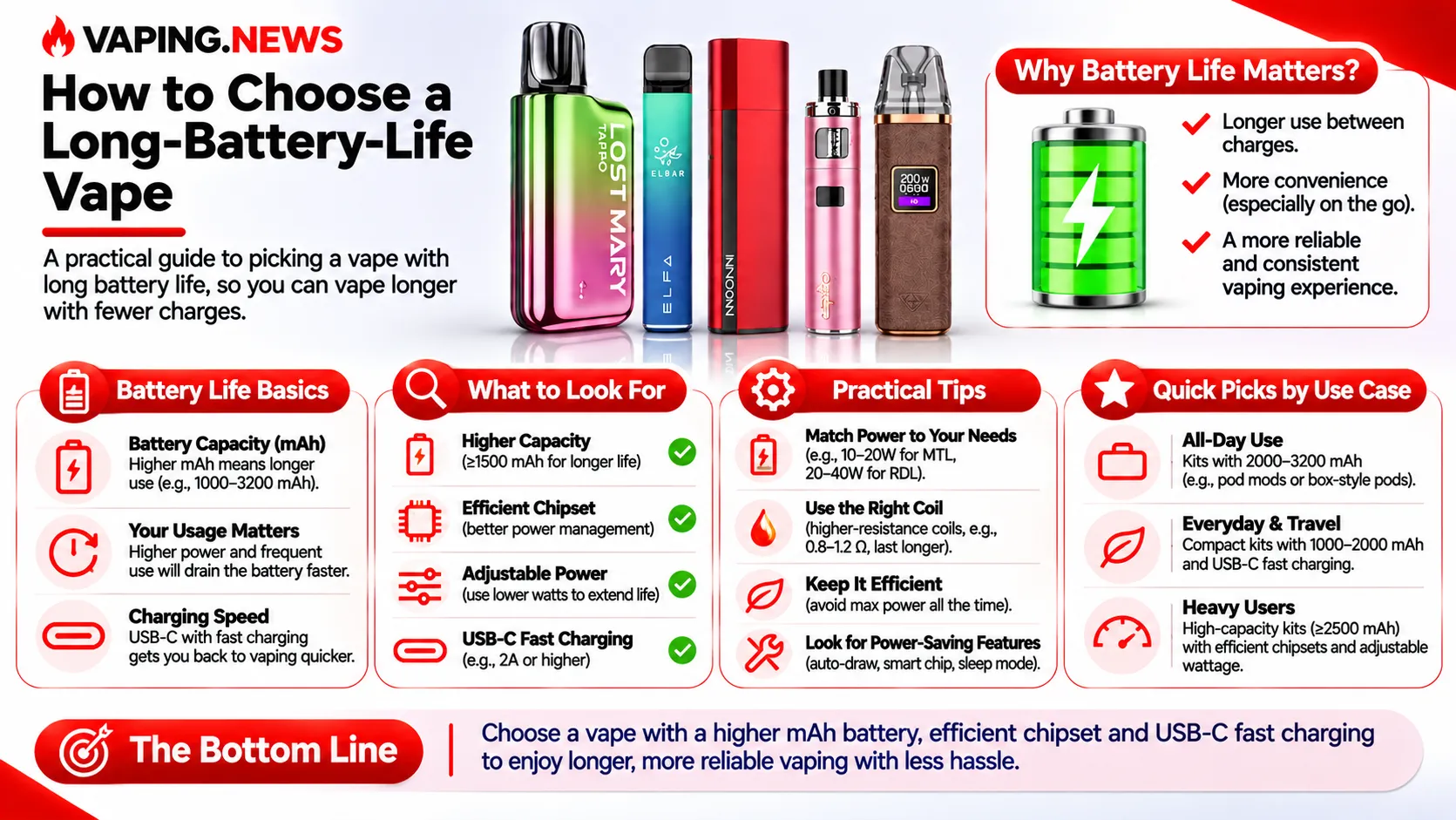
To choose a long-battery-life vape, compare how much energy the battery stores with how much power the device draws: a larger battery running a higher-resistance coil at low wattage lasts far longer than the same battery driving a sub-ohm coil. In practice, look for a high stated capacity in mAh or Wh, a vaping style that suits low wattage, and a device you keep cool and charge sensibly, because heat and constant full charges shorten battery life over time.
The guide explains what decides battery life, how to turn mAh into watt-hours and estimated puffs, why wattage matters more than capacity, how coils and battery types change the result, how batteries age, and how to compare claims between kits. The estimates use a simple formula with stated assumptions. They are planning figures, not test results for any named device. Vaping is for adult smokers and existing adult vapers only, and the NHS says non-smokers and young people under 18 are not to take up vaping.
What Decides How Long a Vape Battery Lasts?
There are 4 things that decide how long a vape battery lasts on one charge: stored energy, power draw, puff length and battery age.
| Factor | Effect on battery life | What you control |
|---|---|---|
| Stored energy | More energy means more vaping time | Choosing a device with a larger battery |
| Power draw (watts) | Higher wattage drains the battery faster | Coil choice and wattage setting |
| Puff length | Longer puffs use more energy each | Your vaping habits |
| Battery age | Older cells hold less charge | Charging habits and heat exposure |
The first 2 factors matter most when choosing a device. The last 2 matter most once you own one.
What Does mAh Actually Tell You?
Milliamp-hours (mAh) tell you how much electrical charge the battery holds, not how long the battery lasts. A 1,000 mAh battery holds twice the charge of a 500 mAh battery, but how long that charge lasts depends on how fast the device uses it.
Two kits with the same mAh give very different real-world results. A 1,000 mAh mouth-to-lung pod kit running at around 12 W lasts far longer than a 1,000 mAh kit pushed to 25 W. Treat mAh as the size of the fuel tank and wattage as the speed you drive.
How Do You Convert mAh Into Watt-Hours?
You convert mAh into watt-hours (Wh) with this formula: Wh = mAh × nominal voltage ÷ 1,000. Watt-hours measure stored energy, which lets you compare batteries with wattage directly.
Common lithium-ion chemistries have a nominal voltage of 3.6 V to 3.7 V per cell, according to Battery University, an industry education resource. Using 3.7 V gives these results:
- 500 mAh: 500 × 3.7 ÷ 1,000 = 1.85 Wh.
- 1,000 mAh: 1,000 × 3.7 ÷ 1,000 = 3.7 Wh.
- 1,500 mAh: 1,500 × 3.7 ÷ 1,000 = 5.55 Wh.
- 3,000 mAh: 3,000 × 3.7 ÷ 1,000 = 11.1 Wh.
Use a Wh figure directly when the manufacturer lists one, because Wh is more useful than mAh alone.
How Do You Estimate Puffs per Charge?
You estimate puffs per charge with this formula: puffs = (Wh × 3,600 × efficiency) ÷ watts ÷ puff length in seconds. Multiplying Wh by 3,600 converts hours into seconds, and dividing by watts gives the seconds of firing time the battery supports.
Real devices lose some energy as heat in the circuitry and stop firing before the battery is completely flat. The calculation uses an illustrative efficiency of 85% (0.85) to allow for that loss. The 85% figure is an assumption, not a measured figure for any product. Worked example for a 1,000 mAh kit at 12 W with 3-second puffs:
- Calculate energy: 1,000 × 3.7 ÷ 1,000 = 3.7 Wh.
- Calculate usable energy in watt-seconds: 3.7 × 3,600 × 0.85 = 11,322.
- Calculate firing time: 11,322 ÷ 12 W = about 944 seconds.
- Calculate puffs: 944 ÷ 3 = about 314 puffs per charge.
The CORESTA Recommended Method No. 81 lab puffing regime uses a 3-second, 55 ml puff every 30 seconds, which is why 3 seconds is used here. Divide by your own puff length when your puffs are longer. Our guide on how puff counts are estimated explains why manufacturer figures and real use differ.
Why Does Wattage Matter More Than mAh?
Wattage matters more than mAh because doubling the wattage halves the puffs, while most kits in the same class differ in battery size by much less than double. The table uses the formula above, with 3-second puffs and the illustrative 85% efficiency.
| Battery | 10 W | 12 W | 25 W | 40 W |
|---|---|---|---|---|
| 500 mAh | about 189 puffs | about 157 puffs | about 75 puffs | about 47 puffs |
| 1,000 mAh | about 377 puffs | about 314 puffs | about 151 puffs | about 94 puffs |
| 1,500 mAh | about 566 puffs | about 472 puffs | about 226 puffs | about 142 puffs |
| 3,000 mAh | about 1,132 puffs | about 944 puffs | about 453 puffs | about 283 puffs |
A 1,000 mAh kit at 12 W gives more puffs than a 1,500 mAh kit at 25 W. A lower-wattage vaping style adds more battery life than a bigger battery does. Our guide to variable wattage shows how to find the lowest setting that still tastes right.
How Does Coil Resistance Affect Battery Life?
Coil resistance affects battery life because lower-resistance coils need more power to vape well, and more power drains the battery faster. Ohm’s law shows the link: at a fixed voltage, power = voltage² ÷ resistance.
| Coil resistance | Power at 3.7 V | Typical style |
|---|---|---|
| 1.2 ohm | about 11.4 W | MTL |
| 0.8 ohm | about 17.1 W | MTL to RDL |
| 0.6 ohm | about 22.8 W | RDL |
| 0.4 ohm | about 34.2 W | RDL to DTL |
| 0.2 ohm | about 68.5 W | DTL |
Most modern pod kits regulate their output rather than sending full battery voltage to the coil, so these numbers show the trend rather than exact settings. The trend holds: a higher-resistance coil is the simplest route to longer battery life. Coil types and resistances are covered in our guide to vape coils.
Which Vaping Style Gives the Longest Battery Life?
Mouth-to-lung (MTL) vaping gives the longest battery life, because MTL coils run at the lowest wattage of the 3 styles. Restricted direct-lung (RDL) runs higher, and direct-lung (DTL) runs highest. The wattage range printed on each coil or pod gives the figure for your own device.
A vaper who moves from DTL to MTL cuts power draw sharply, and by the formula above, halving the wattage doubles puffs per charge on the same battery. MTL pairs with higher nicotine strengths and lower vapour volume, so the switch changes the whole experience, not only battery life. The 3 styles are compared in our guide to MTL vs RDL vs DTL vaping.
Are Built-In or Removable Batteries Better for Endurance?
Removable batteries are better for endurance because a flat cell is swapped for a charged one in seconds. Built-in batteries are better for compactness and simplicity.
| Factor | Built-in battery | Removable 18650 or 21700 cell |
|---|---|---|
| Capacity | Limited by device size | Usually higher, and dual-cell mods double the total |
| Swapping | Not possible; you recharge the device | Carry a charged spare and swap |
| Replacement when worn | Device is usually replaced | Replace the cell only |
| Safety handling | Sealed inside the device | Requires correct cells, intact wraps and a case for spares |
Keep spare cells in a plastic battery case and away from metal items, as government battery safety advice recommends, because loose cells touching keys or coins risk a short circuit. The full comparison sits in our guide to internal vs removable vape batteries.
Dual-cell devices running 2 removable 18650 or 21700 cells give the longest endurance of any vape format, at the cost of size and weight. These devices are covered in our guide to box mod kits.
How Much Does Battery Life Drop With Age?
Battery life drops steadily with age, because lithium-ion cells lose capacity with each charge cycle and with time spent hot or fully charged. Battery University guidance on lithium-ion cells, an industry education source, reports that a cell charged to 4.20 V per cell typically delivers 300 to 500 cycles, and that heat speeds up permanent capacity loss.
Expect a kit that lasts all day when new to need an earlier recharge after many months of daily use. Buy a little more capacity than you need today, so the device still covers your day as the battery ages.
Does Fast Charging Make Up for a Smaller Battery?
Yes, partly. Fast USB-C charging makes a smaller battery more practical, because a short top-up during a break covers the rest of the day. Fast charging adds no capacity, so a small battery still runs flat sooner between charges.
Compare both capacity and stated charging time between kits. A kit that recharges quickly from a standard USB-C charger suits someone with regular access to power. A kit with a larger battery suits someone away from chargers for long stretches. Charging speed and safety are covered in our guide to USB-C vape charging.
Which Features Drain a Vape Battery Faster?
There are 5 features that drain a vape battery faster:
- High wattage: the biggest single drain, as the puff table shows.
- Bright screens: colour displays and animations use power between puffs.
- Boost modes: pre-heat or boost settings briefly draw more power.
- Long puffs: a 5-second puff uses about two-thirds more energy than a 3-second puff.
- Cold weather: lithium-ion cells deliver less usable energy when cold, and Battery University notes the capacity returns once the cell warms up.
Switching off animations and boost modes is the quickest gain on a screen-equipped device.
Cold affects charging more than use. Consumer lithium-ion cells cannot be charged below 0°C, and Battery University warns that a sub-freezing charge plates lithium metal on the anode and causes permanent harm to performance and safety. Let a cold device warm to room temperature before plugging it in.
How Do You Compare Battery Claims Between Kits?
You compare battery claims by putting every kit through the same formula at the same wattage and puff length. Follow these 4 steps:
- Find the stated mAh, or Wh where listed, for each kit.
- Note the wattage you will actually vape at, based on the coil you plan to use.
- Estimate puffs with the formula, using the same efficiency and puff length for each kit.
- Compare the result with your own daily puff count, found by counting puffs for 1 hour and multiplying by your waking hours of vaping.
Treat “all-day battery” and similar phrases as marketing, not measurements. A claim without a stated wattage and puff length gives no basis for comparison.
How Can You Make Any Vape Battery Last Longer?
You make any vape battery last longer by lowering power draw and protecting the cell from stress.
- Lower the wattage: use the lowest setting that still gives good flavour.
- Choose higher-resistance coils: pick MTL coils when your style allows.
- Charge partially: Battery University notes that partial charges and discharges reduce stress on lithium-ion cells, and advises avoiding full discharges.
- Keep the device cool: avoid hot cars, sunny windows and charging under pillows.
- Use the right charger: charge with the charger supplied with the vape, do not charge overnight, and stop using any device that swells, gets very hot or smells of burning.
Damaged or swollen batteries are a fire risk. Stop using the device, keep the device out of household waste and household recycling, and take it to a vape-only recycling bin or recycling point, as the Office for Product Safety and Standards advises. Built-in protections such as overcharge and short-circuit cut-offs are explained in our guide to vape chipsets and safety protections.
What Are the Frequently Asked Questions About Long-Battery-Life Vapes?
How many mAh is a good vape battery?
No single mAh figure is right for everyone, because power draw decides how long the charge lasts. Use the formula in this guide with your own wattage and puff length. Higher-wattage devices need far more capacity, which is why many sub-ohm devices use removable 18650 or 21700 cells.
How long does a 1,000 mAh vape last?
A 1,000 mAh vape lasts around 300 puffs per charge at 12 W with 3-second puffs, based on the planning formula in this guide. At 25 W the figure drops to around 150 puffs. Real results vary with puff length, settings and battery age.
Is a higher mAh vape always better?
No. A higher mAh vape lasts longer only when wattage and puff length stay the same. A larger battery adds size and weight, and a high-power coil drains it quickly. A smaller battery at low wattage often outlasts a larger battery at high wattage.
Why does my vape battery die so fast?
A vape battery dies fast when wattage is high, puffs are long, the coil resistance is low or the battery is old. Lower the power, fit a higher-resistance coil and turn off boost modes. A sudden drop after months of use usually signals a worn cell.
Can I leave my vape charging overnight?
No. Government battery safety advice says not to charge a vape overnight and to check the device regularly while it charges. Use the charger supplied with the vape, unplug once full, and stop using any device that swells or gets hot.
How long does a vape battery last before replacement?
A vape battery charged to 4.20 V per cell typically lasts 300 to 500 cycles, according to Battery University guidance on lithium-ion cells. For a daily user charging once a day, 300 to 500 charges covers roughly 10 to 16 months. Heat and constant full charges shorten that life.
Do removable batteries last longer than built-in batteries?
Removable batteries give longer total vaping time, because a charged spare is swapped in seconds and larger 21700 cells hold more energy. A built-in battery cannot be swapped. Removable cells need careful handling, intact wraps and a plastic case for spares.
Does vaping at lower wattage save battery?
Yes. Vaping at lower wattage saves battery in direct proportion: halving the wattage roughly doubles the puffs per charge. Use the lowest setting within the coil’s printed range that still gives good flavour and warmth. Running below the range gives weak, cool vapour.
Is it bad to let a vape battery run flat?
Yes, regularly running a vape battery completely flat stresses lithium-ion cells and shortens their life, according to Battery University. Recharge when the indicator shows low rather than waiting for the device to stop firing. Partial charges put less stress on the cell than full cycles.
Why is my vape battery draining when not in use?
A vape battery drains when not in use when a screen, standby mode or faulty board keeps drawing power. Cold reduces the charge a cell delivers until it warms up. Lock or switch off the device between sessions, and seek a replacement when overnight drain is large.
Does cold weather affect vape battery life?
Yes. Cold weather reduces vape battery life, because lithium-ion cells deliver less usable energy at low temperatures. Keep the device in an inside pocket in winter. Capacity returns once the cell warms up, but repeated charging below freezing damages the battery.
Are big puff vape kits better for battery life?
No, not by default. Big puff kits pair a larger battery with more e-liquid, but battery life still depends on wattage and puff length. Puff claims on packaging are manufacturer estimates, and real use varies. Compare kits with the formula rather than the printed puff figure.
How do I check my vape battery health?
To check vape battery health, compare how long a full charge lasts now with how long the same charge lasted when new, using the same coil and wattage. A clear, lasting drop in run time signals a worn cell. Swelling, heat or damaged wraps mean stopping use immediately.
What is the safest way to carry spare vape batteries?
The safest way to carry spare vape batteries is inside a plastic battery case, one cell per slot, away from metal items. Loose cells touching keys, coins or each other risk a short circuit. Check wraps for tears before use, and replace any damaged cell straight away.
How do I dispose of an old vape battery?
To dispose of an old vape battery, take the device or cell to a battery or electrical recycling point, such as a household waste recycling centre or retailer take-back bin. Never put vape batteries in household waste or household recycling, because a damaged battery can start a fire.
One thought on “How to Choose a Long-Battery-Life Vape”
Comments are closed.