

Last updated: 28 October 2026
Vaping.news content is for adults aged 18 and over. Vaping products are for adult smokers. Nicotine is a highly addictive substance, and vaping is not risk-free.
To choose a nicotine strength when switching from smoking, match the strength to how much and how soon you smoke each day, then adjust it in the first 2 weeks until cravings for cigarettes stay under control. NHS Better Health puts the rule simply: start at a nicotine level that matches your cigarette use, with enough nicotine to reduce withdrawal symptoms and urges to smoke. Heavier smokers generally need a higher strength.
Vaping.news wrote this guide for adult smokers making the switch. The sections below cover how to read your own smoking pattern, how roll-up smokers choose, how nicotine salts and freebase nicotine differ for cravings, how your device changes the answer, and why a strength below your needs is one of the main reasons people slip into smoking and vaping at the same time.
Why Does Nicotine Strength Matter When You Switch?
Nicotine strength matters because the vape has to replace the nicotine your body currently gets from cigarettes, or cravings pull you back to smoking. Nicotine is the addictive part of tobacco, but the NHS states that most of the harm from smoking comes from the many other toxic chemicals in tobacco smoke.
The OHID 2022 evidence update found that vaping products provide lower peak nicotine levels than smoking, usually delivered more slowly than a cigarette. A strength that feels fine on a quiet evening leaves you short during a stressful day. The goal in the first weeks is to feel satisfied enough that a cigarette is not tempting, not to minimise nicotine.
Nicotine itself helps people quit. The Cochrane review of e-cigarettes for smoking cessation (updated 26 August 2026) found that about 8 to 10 in every 100 people using nicotine e-cigarettes stopped smoking, compared with about 6 in 100 using e-cigarettes without nicotine.
How Is Nicotine Strength Measured?
Nicotine strength is measured in milligrams of nicotine per millilitre of e-liquid (mg/ml), and sometimes as a percentage. A 20 mg/ml e-liquid contains 20 mg of nicotine in every 1 ml, which equals 2%. Divide the mg/ml figure by 10 to get the percentage.
A full 2 ml (0.07 fl oz) pod of 20 mg/ml e-liquid therefore holds 40 mg of nicotine, and a 10 ml (0.34 fl oz) bottle at 12 mg/ml holds 120 mg. The body absorbs only part of the nicotine in the liquid, so these totals do not equal the dose you receive. The vaping glossary defines the other terms on e-liquid labels.
Keep pods and bottles out of reach of children. If you think a child has swallowed e-liquid, NHS poisoning advice is to call 999 or go to A&E, and to call NHS 111 if you are not sure whether something swallowed is harmful.
What Nicotine Strengths Are Available in the UK?
UK e-liquids range from 0 mg/ml up to a legal maximum of 20 mg/ml (2%), set by regulation 36 of the Tobacco and Related Products Regulations 2016.
The NCSCT vaping guide for health professionals lists 3, 6, 12 and 18 mg/ml as the most common strengths, while nicotine salt e-liquids stay smooth at higher strengths up to the same 20 mg/ml limit. The table below shows 6 common strengths and their typical use.
| Strength | Percentage | Typical use for a switching smoker |
|---|---|---|
| 20 mg/ml | 2% | Heavy or very dependent smokers using a low-power pod device |
| 18 mg/ml | 1.8% | Heavy smokers using a pen or pod device with freebase liquid |
| 12 mg/ml | 1.2% | Moderate smokers; the NCSCT says new pen-style or tank users can start here |
| 10 mg/ml | 1% | Moderate smokers using nic salts in a pod device |
| 6 mg/ml | 0.6% | Light smokers, or sub-ohm devices that produce large clouds |
| 3 mg/ml | 0.3% | Sub-ohm users and people stepping down after switching |
Nicotine e-liquid in the UK comes in refill bottles of a maximum of 10 ml, with child-resistant and tamper-evident packaging, and every product is notified to and published by the MHRA before sale. The UK e-cigarette product regulations page sets out each rule.
How Many Cigarettes Do You Smoke a Day?
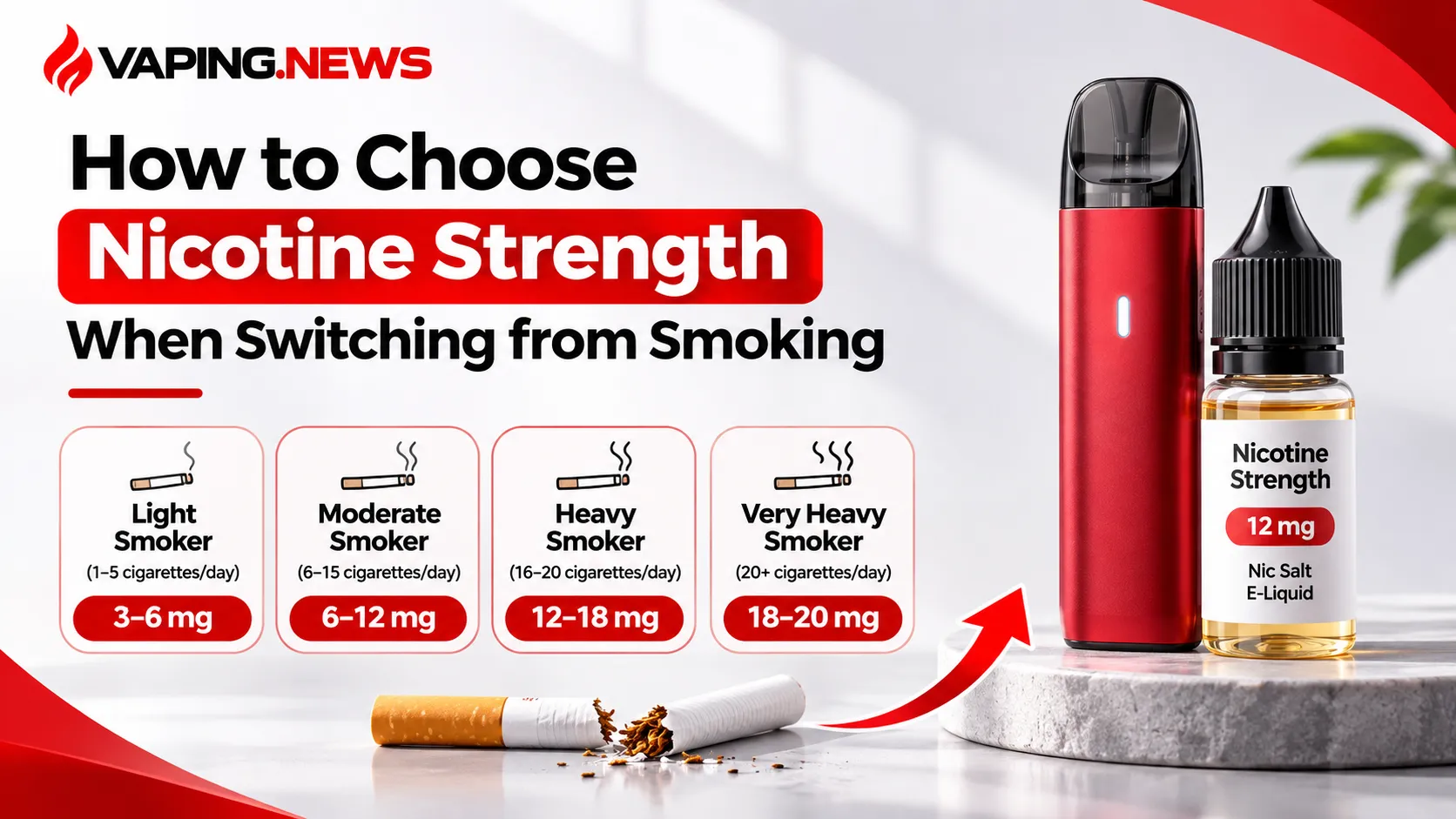
The number of cigarettes you smoke a day is the simplest starting guide, because more cigarettes usually means higher nicotine dependence. According to the NCSCT, more dependent smokers generally benefit from higher nicotine doses. The bands below are Vaping.news starting points based on that principle, and they are a guide, not a clinical prescription.
| Cigarettes per day | Pod device (nic salt) | Pen or tank device (freebase) |
|---|---|---|
| More than 20 | 20 mg/ml | 18 mg/ml |
| 11 to 20 | 20 mg/ml or 10 mg/ml | 12 to 18 mg/ml |
| 5 to 10 | 10 mg/ml | 6 to 12 mg/ml |
| Fewer than 5, or social smoking | 5 to 10 mg/ml | 3 to 6 mg/ml |
Start at the higher strength when you fall between 2 bands. NHS Better Health tells switchers not to worry if they are vaping more than they used to smoke, and stepping down later is easier than recovering from a relapse.
What Is the Heaviness of Smoking Index?
The Heaviness of Smoking Index is a 2-question score that measures nicotine dependence, and the NCSCT names it as a way to guide your starting strength. The score combines the number of cigarettes per day with how soon you smoke after waking, using the scoring in the NCSCT dependence questionnaire. Score each question with the 2 tables below.
| Cigarettes smoked a day | Score |
|---|---|
| 10 or fewer | 0 |
| 11 to 20 | 1 |
| 21 to 30 | 2 |
| 31 or more | 3 |
| Time to first cigarette after waking | Score |
|---|---|
| Within 5 minutes | 3 |
| 6 to 30 minutes | 2 |
| 31 to 60 minutes | 1 |
| After 60 minutes | 0 |
Add the 2 scores together for a total from 0 to 6, where a higher score means heavier smoking and stronger dependence. A smoker who lights up within 5 minutes of waking scores 3 on that question alone, even on 15 cigarettes a day, and is likely to need a higher strength than the daily count alone suggests.
How Do Roll-Up Smokers Choose a Strength?
Roll-up smokers choose a strength using time to first smoke and craving patterns, not a cigarette count, because hand-rolled cigarettes vary so much in size and tobacco content. One roll-up is a thin, short smoke, and another lasts twice as long. Use these 5 steps:
- Work out how long a pouch of tobacco lasts you, and how many roll-ups you make from it.
- Score the “time to first cigarette” question from the Heaviness of Smoking Index above.
- Start at 18 to 20 mg/ml when you smoke within 30 minutes of waking or get through a pouch quickly.
- Start at 10 to 12 mg/ml when you smoke later in the day and only a few roll-ups.
- Track cravings for 1 week and adjust.
Many roll-up smokers are used to a strong throat sensation. A freebase e-liquid at a higher strength gives a sharper throat hit, which some former roll-up smokers find more familiar, while others prefer the smoother feel of nic salts. Both are valid choices.
Are Nic Salts or Freebase Better for Cravings?
Nic salts are usually the easier choice for heavier smokers who need strong craving relief, because they allow high nicotine strengths with a smoother throat feel. The NCSCT describes nicotine salts as a smoother experience with less throat hit, and a good starter e-liquid for new users. According to the OHID review, nicotine exposure from vaping rises with higher e-liquid concentration and with nicotine salt use. The table below compares 4 factors.
| Factor | Nic salt | Freebase |
|---|---|---|
| Throat feel at high strength | Smoother | Harsher, stronger throat hit |
| Usual strengths | Up to 20 mg/ml | 3 to 18 mg/ml |
| Best device match | Low-power pod kits, MTL draw | Pen kits, MTL tanks, sub-ohm tanks |
| Suits | Heavier smokers wanting a quick, satisfying hit | Smokers who like a strong throat sensation, or who use larger devices |
The right choice is the one that stops you reaching for a cigarette. The guide to nicotine salts explains how the salt form smooths the throat hit.
Smokers who prefer a sharper throat feel or use a larger device usually choose freebase nicotine, which comes in a wider range of low strengths.
Does Your Device Change the Strength You Need?
Yes. Your device changes the strength you need, because devices that produce more vapour deliver more nicotine per puff. The NCSCT notes that higher nicotine concentrations are usually needed with smaller devices, because of their less powerful batteries. Match strength to 3 device types:
- Small pod kits: low power, small vapour and a mouth-to-lung (MTL) draw like a cigarette, paired with 10 to 20 mg/ml nic salts.
- Pen and MTL tank kits: moderate vapour, paired with 6 to 18 mg/ml freebase.
- Sub-ohm tanks: large vapour and a direct-to-lung draw, paired with 3 to 6 mg/ml freebase. Sub-ohm devices produce far more vapour per puff, so they pair with low strengths.
Most switching smokers find an MTL pod kit the easiest first device, because the draw feels closest to a cigarette. The page on MTL vs RDL vs DTL vaping explains each draw style.
Does the VG/PG Ratio Affect Nicotine Strength?
The VG/PG ratio does not change the nicotine strength, but it changes how the nicotine feels and which device suits the liquid. Propylene glycol (PG) carries flavour and gives more throat hit, while vegetable glycerine (VG) makes thicker vapour and a smoother feel.
High-PG and 50/50 liquids suit pod kits and MTL tanks, which pair with higher strengths. High-VG liquids suit sub-ohm tanks, which pair with low strengths. The guide to VG/PG ratios sets out which ratio fits each device.
What Are the Signs Your Strength Is Not High Enough?
The main signs your strength is not high enough are persistent cravings for cigarettes, vaping almost constantly without feeling satisfied, and irritability or restlessness. The OHID review found that people who vape compensate for lower nicotine concentrations by compensatory puffing. Watch for these 4 signs in your first 2 weeks:
- Cravings for a cigarette continue after vaping.
- Long chain-vaping sessions still leave you unsettled.
- E-liquid or pods run out much faster than expected.
- Cigarettes end up in your shopping “just for today”.
Step up one strength level when 2 or more of these apply, before cravings lead you back to tobacco.
What Are the Signs Your Strength Is Higher Than You Need?
The signs that your strength is higher than you need are headaches, feeling sick or a throat hit that makes you cough. The NCSCT lists throat or mouth irritation, headache, cough and feeling sick as the unwanted effects most often reported from vaping, and these tend to reduce over time as people continue vaping.
Take fewer puffs in a row and wait to see if symptoms pass. Drop one strength level when symptoms continue over several days, and speak to a pharmacist or stop smoking adviser about persistent symptoms.
Why Is Under-Dosing a Dual Use Risk?
Under-dosing is a dual use risk because a vape that does not satisfy cravings leaves a gap that cigarettes fill. Dual use means smoking and vaping during the same period, and it removes most of the health benefit of switching. Three authorities set out the problem:
- NHS view: you will not get the full benefit from vaping unless you stop smoking cigarettes completely.
- CDC view: the US Centers for Disease Control and Prevention states that dual use “is not an effective way to safeguard health”, and that smoking even a few cigarettes a day can be dangerous.
- NCSCT view: cutting down the number of cigarettes smoked does not convey health benefits, because of compensatory smoking, where each remaining cigarette is smoked harder.
Choosing a strength that is high enough from day one is the single most practical step to avoid dual use. The guide to switching completely from smoking to vaping covers the rest of the plan.
When Can You Lower Your Nicotine Strength?
You can lower your nicotine strength once you have been completely smoke-free for several weeks and cigarettes no longer tempt you. No fixed timetable applies. Stopping smoking is the priority, and reducing nicotine is a second, later step. Follow these 4 steps:
- Stay at your starting strength until you have gone at least a month without a cigarette.
- Drop one level, for example from 18 to 12 mg/ml, or from 20 to 10 mg/ml nic salt.
- Stay at each new level for at least 2 weeks.
- Go back up a level without guilt when cravings for cigarettes return.
NHS Better Health advises aiming to quit vaping once you feel sure you will not go back to smoking. Personal advice on strength is free from your local NHS Stop Smoking Service, and NHS Better Health points switchers to a specialist vape shop or a Stop Smoking Service for advice. Vaping is for adult smokers only: people who do not smoke do not need to start.
What Are the Frequently Asked Questions About Nicotine Strength for Switching Smokers?
What nicotine strength is equal to 20 cigarettes a day?
No exact strength equals 20 cigarettes a day, because nicotine delivery depends on device, power and puffing style. Smokers on about 20 a day commonly start at 18 to 20 mg/ml in a pod kit. Adjust within the first 2 weeks until cravings for cigarettes stay under control.
Is 20 mg nic salt right for a beginner?
Yes, for a heavy smoker. A 20 mg/ml nic salt is a normal starting strength for a beginner who smokes heavily. Nic salts feel smoother than freebase at the same strength. Light smokers usually do better at 10 mg/ml. Drop a level if you get headaches or feel sick for several days.
Is 3 mg nicotine enough for a smoker?
No, not for most smokers using a pod kit. A 3 mg/ml strength suits sub-ohm devices that produce large clouds, or people stepping down after switching. A smoker using a small pod kit at 3 mg/ml usually under-doses, which leads to cravings and a higher risk of returning to cigarettes.
What is the strongest legal nicotine strength in the UK?
The strongest legal nicotine strength in the UK is 20 mg/ml, or 2%, under the Tobacco and Related Products Regulations 2016. E-liquids above 20 mg/ml cannot be legally sold as consumer vaping products. Products sold above the limit are illegal and are a sign of an unregulated product.
How much nicotine is in one cigarette?
The nicotine in a cigarette’s tobacco does not convert directly into an e-liquid strength. A smoker absorbs only part of that nicotine, and the amount varies with how the cigarette is smoked. Vaping delivers nicotine differently again, so match your strength to cravings and dependence, not to the cigarette label.
Can I mix two nicotine strengths together?
Yes. Mixing equal amounts of 2 strengths gives a strength halfway between them, so 18 mg/ml and 6 mg/ml mixed 1 to 1 gives 12 mg/ml. Mix only liquids of the same type and VG/PG ratio, in a clean labelled container, and keep the mix away from children.
Why does my throat hurt when I vape high nicotine?
Your throat hurts when you vape high nicotine because freebase nicotine gives a stronger throat hit at higher strengths. Switching to a nic salt at the same strength, lowering the power or using a higher VG liquid usually helps. A sore throat that lasts weeks needs a GP check.
How long does it take to adjust to a new nicotine strength?
Adjusting to a new nicotine strength usually takes a few days to 2 weeks. Mild headaches or cravings in the first days are common after a change. Stay at each new level for at least 2 weeks before deciding, and step back up when cravings for cigarettes return.
Does higher nicotine strength mean more harm?
Not for a smoker who switches completely. Nicotine is addictive, but the NHS says most of the harm from smoking comes from the other toxic chemicals in tobacco smoke. The bigger risk for a switcher is under-dosing and returning to cigarettes.
What nicotine strength suits a social smoker?
A social smoker who smokes fewer than 5 cigarettes a day usually suits 5 to 10 mg/ml in a pod kit, or 3 to 6 mg/ml freebase in a larger device. Social smokers who do not smoke at all between social events gain nothing from starting to vape daily.
Can I get nicotine poisoning from vaping?
Headaches and feeling sick are signs of more nicotine than you need, so take fewer puffs and drop a strength level. Swallowed e-liquid is the bigger worry, especially for children. If you think a child has swallowed e-liquid, NHS poisoning advice is to call 999 or go to A&E.
Is nicotine-free vaping a good way to quit smoking?
No, not for most smokers. The Cochrane review (2026) found nicotine-free e-cigarettes helped about 6 people per 100 quit, compared with 8 to 10 per 100 using nicotine e-cigarettes. Nicotine controls withdrawal symptoms, so starting with nicotine and reducing later works better for most smokers.
Does vaping more often mean my strength is wrong?
Vaping more often in the first weeks is normal and does not always mean your strength is wrong. NHS Better Health tells switchers not to worry if they vape more than they used to smoke. Constant vaping with continued cigarette cravings, however, signals a strength below your needs.
How do I step down from 20 mg/ml nic salt?
To step down from 20 mg/ml nic salt, move to 10 mg/ml nic salt once you have been smoke-free for at least a month. Stay at 10 mg/ml for at least 2 weeks, then move to 5 mg/ml or a low-strength freebase. Go back up when cigarette cravings return.
Who can advise me on the right nicotine strength?
Your local NHS Stop Smoking Service, a pharmacist or a specialist vape shop can advise on the right nicotine strength. NHS Better Health recommends stop smoking services and specialist vape shops for this help. Some local services offer a free vaping starter pack to adult smokers.
One thought on “How to Choose Nicotine Strength When Switching from Smoking”
Comments are closed.