

Last updated: 9 November 2026
Vaping.news content is for adults aged 18 and over. Vaping products are for adult smokers. Nicotine is a highly addictive substance, and vaping is not risk-free.
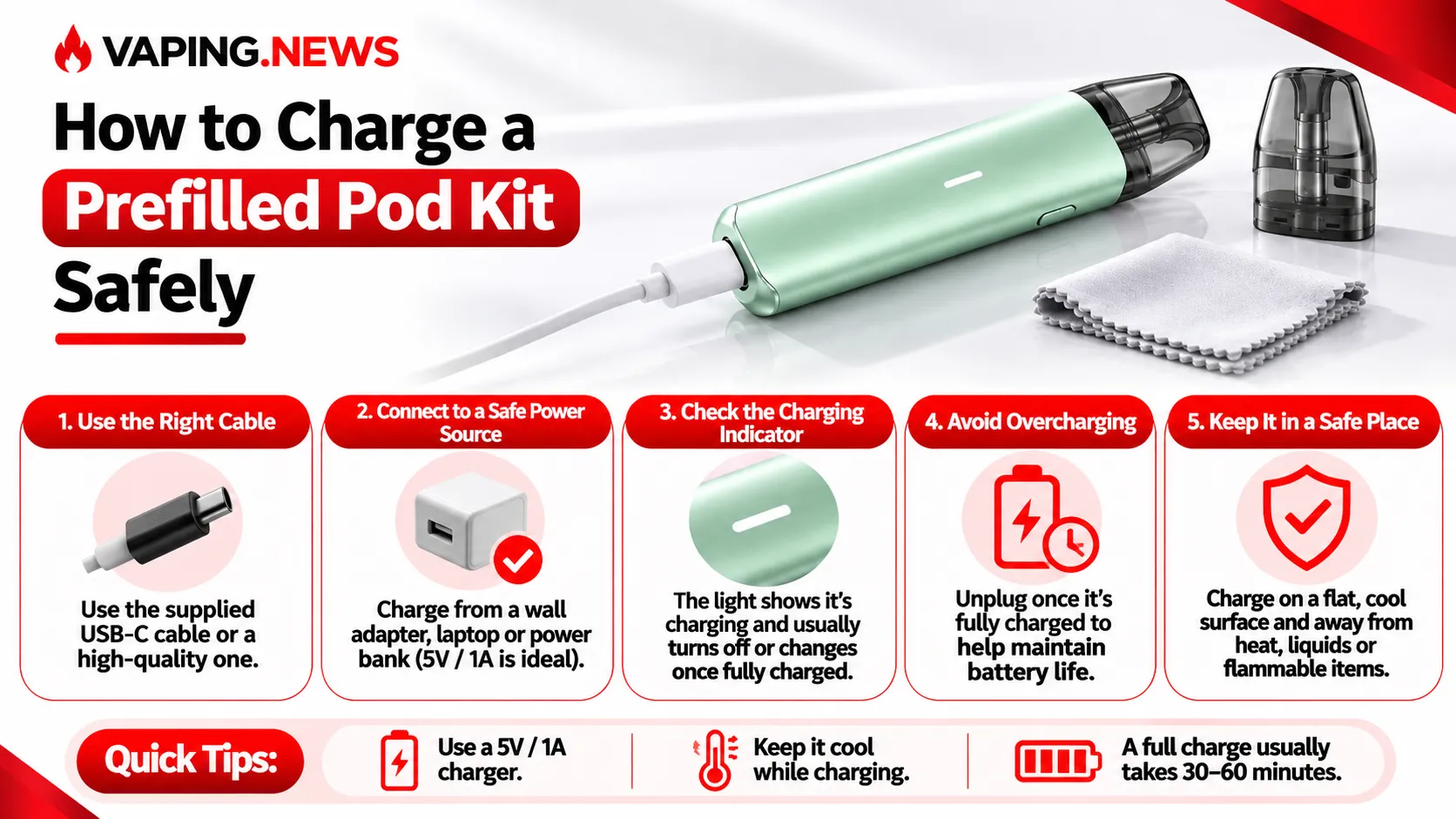
To charge a prefilled pod kit safely, use the charger or cable the maker supplies or recommends, charge the kit on a hard, flat surface while you are nearby, and unplug it once the light or screen shows full. Stop using any kit that gets hot, swells, hisses or smells while charging. A prefilled pod kit is a reusable vape with a rechargeable battery and replaceable sealed pods, so the battery is charged many times over its life. The sections below cover the charging steps, charge times, cables and plugs, pass-through charging, overnight charging, warning signs of a battery fault, battery care, travel rules and safe disposal in the UK.
How Do You Charge a Prefilled Pod Kit Step by Step?
You charge a prefilled pod kit in 5 simple steps, using the charging port on the device body. The steps below suit most kits sold in the UK, and the maker’s manual has the final word.
- Check that the charging port is dry and free of e-liquid, fluff and dust.
- Connect the supplied or recommended cable to the kit and to a USB plug or computer port.
- Place the kit on a hard, flat surface such as a desk, worktop or tiled shelf.
- Watch the battery light or screen, which flashes, glows or shows a rising percentage while the kit charges.
- Unplug the kit once the light changes colour, stops flashing or the screen reads 100%.
Each manual explains what its own light pattern means, so read the light codes once when you first buy the kit. Cheshire Fire and Rescue Service advises people to charge on hard, flat surfaces, use the correct charger and unplug when done.
The same routine applies to the first charge after you activate a prefilled pod kit, because many new kits arrive with only a partial charge.
How Long Does a Prefilled Pod Kit Take to Charge?
A prefilled pod kit takes as long as its battery capacity and charge current allow, and the maker states the expected charge time in the manual or on the product page. Small pocket kits with smaller batteries usually charge fastest, while big puff kits with screens and larger cells usually take longest. The table below gives the general pattern.
| Kit type | Battery size | Charge time from empty |
|---|---|---|
| Compact prefilled pod kit | Smaller | Usually the shortest |
| Mid-size prefilled pod kit | Medium | In between |
| Big puff kit with screen | Larger | Usually the longest |
Manufacturer charge times are estimates measured with a matching plug and cable. A low-power computer port, a long thin cable or a cold room adds time, and a partly charged battery tops up faster than a flat one. Vaping.news has not tested charge times on these kits.
Which Cable and Plug Are Safe to Use?
The safest choice is the charger supplied with the kit, or the cable and plug type the maker recommends. The London Fire Brigade says that if your device came with a charger, only use that charger. Many prefilled kits ship with only a cable, so buy a replacement from an established electronics retailer rather than a market stall or an unknown online seller.
Some prefilled kits show no charging light on one cable type but charge on another, such as a USB-A to USB-C cable in place of a USB-C to USB-C cable. Try the cable type listed in the manual when a kit shows no charging light. The guide to USB-C vape charging explains charge speeds, cable types and compatibility in more detail.
Is a Fast Phone Charger Safe for a Prefilled Pod Kit?
A fast phone charger is a second choice, used only where the maker’s manual allows it. Chargers built to the USB Power Delivery standard let each device take only the power it requires, so the kit’s own charging circuit controls the current. Fire services still advise the correct charger for each device, and the risk rises with cheap, unbranded or damaged plugs. When in doubt, use the charger supplied with the kit.
What Safety Protections Does a Prefilled Pod Kit Have?
A prefilled pod kit has a small circuit board that controls charging and firing. Many kits include 4 core protections:
- Overcharge protection, which stops charging when the cell is full.
- Over-discharge protection, which cuts power before the cell drains to a damaging level.
- Short-circuit protection, which shuts the device down when the pod or contacts short.
- Firing time cut-off, which stops a puff after a set number of seconds stated in the manual.
Hereford and Worcester Fire and Rescue Service advises vapers to check the battery has overcharge or overheat protection. These protections reduce risk but do not remove the need for sensible charging habits. The page on vape chipsets and safety protections explains how each protection works inside regulated devices.
Can You Vape While a Prefilled Pod Kit Is Charging?
Yes, you can vape while charging on kits that support pass-through charging, and no on kits that pause firing while plugged in. Pass-through charging means the device fires while connected to power. The manual states whether a kit supports pass-through charging. Kits without the feature either ignore the draw or flash a warning light. Keep sessions on charge short, and unplug the kit if the body feels warm.
Is Overnight Charging Safe?
No, overnight charging is not advised for any vape. The NHS says to never leave a vape charging unattended or overnight, and the London Fire Brigade gives the same advice. A person who is awake and nearby spots a fault early, while a sleeping household does not.
Charge the kit during the day or evening and unplug it once full. Cheshire Fire and Rescue Service advises installing smoke alarms near charging areas, never charging while sleeping or unattended and keeping escape routes clear of charging devices.
What Are the Warning Signs of a Battery Fault?
A lithium-ion battery often shows clear physical signs before a failure. Watch for the following signs while charging and vaping:
- Heat that makes the body hot to touch during charging.
- Swelling or bulging that bends the casing or stops the pod from fitting.
- Hissing, popping or crackling from the device body.
- A strong or unusual smell that does not come from the pod.
- Rapid charge loss, where the battery drops from full to empty within a few puffs.
The London Fire Brigade says to stop using a battery at once if it gets unusually hot, starts to bulge or starts hissing, and to protect batteries from crushing or puncture. Unplug the kit, move it onto a non-flammable surface away from anything that burns and stop using it. Never try to open a swollen battery. Take the kit to a recycling point and replace it.
Why Does a Kit Not Charge?
A kit does not charge for 5 common reasons: a faulty cable, a weak or switched-off power source, e-liquid or dirt in the port, a fully drained battery that needs a few minutes to wake, or a cable type the kit does not accept. Work through the checks in order:
- Try a second cable and a second plug.
- Inspect the port with a torch and remove fluff with a dry wooden toothpick.
- Leave the kit connected for several minutes before deciding the battery is dead.
- Switch between USB-A to USB-C and USB-C to USB-C cables.
- Contact the retailer if the kit still shows no light.
Never use a metal pin in the port, and never charge a kit with a wet port. The vape troubleshooting guide covers other faults such as blinking lights, no vapour and pods not detected.
Does the Battery Ever Need Replacing?
Yes, the battery wears out over time, because every lithium-ion cell loses capacity with each charge cycle. Battery University, an industry educational resource rather than an official source, gives typical figures of 300 to 500 full cycles for a cell charged to 4.20 V, with more cycles from shallower discharges.
Most prefilled pod kits have a sealed internal battery, so the whole device is replaced when the battery fades. A few big puff kits have a detachable battery section. The comparison of internal vs removable vape batteries explains the trade-offs for each design.
How Do You Look After the Battery?
You look after the battery by avoiding heat, deep drains and dirty contacts. The habits below help battery life:
- Recharge the kit before the battery is completely flat.
- Keep the kit out of hot cars, windowsills and direct sunlight.
- Keep the charging port free of e-liquid and pocket dust.
- Store a kit you are not using partly charged rather than full or empty.
- Remove a leaking pod before charging, and dry the pod bay with a tissue.
Battery University recommends storing lithium-ion cells at around 40 percent charge, and the London Fire Brigade warns that direct sunlight or freezing temperatures can damage the battery. The guide on how to store prefilled vape pods covers pod storage in detail.
Can You Take and Charge a Prefilled Pod Kit on a Plane?
You can take a prefilled pod kit on a plane in hand luggage only, and you cannot vape on board. The Civil Aviation Authority says to keep vapes in the cabin and never pack them in checked luggage, because they can overheat and cause a fire, and never to vape onboard an aircraft.
Do not charge the kit in flight. The CAA says power banks must not be charged on any flight, and that a vape which starts to get hot needs switching off. Check your airline’s rules and the vaping laws of your destination before you travel, because some countries ban vapes completely.
How Do You Dispose of a Kit with a Dead Battery?
You dispose of a dead kit at a vape retailer or a household waste recycling centre. Retailers selling vapes in store or online must offer free take-back under the WEEE Regulations, and vape retailers cannot use the Distributor Takeback Scheme in place of that duty.
Never put a vape in a household bin. The NHS warns that batteries in binned vapes can become damaged and cause fires in refuse vehicles. Some kits have a battery that detaches for separate recycling. Since the UK single-use vape ban took effect on 1 June 2025, a legal vape needs a rechargeable battery, so correct charging and recycling matter more than ever.
What Are the Frequently Asked Questions About Charging Prefilled Pod Kits?
How do I know when my prefilled pod kit is fully charged?
To know when your kit is fully charged, watch the battery light or screen. Many kits change the light colour, stop flashing or show 100% on the screen once charging ends. The exact pattern differs between brands, so check the light codes in the manual. Unplug the kit once it reaches full charge, as fire services advise.
Can I charge my vape with a laptop?
Yes, when the manual allows a computer port. A laptop USB port often supplies less current than a wall plug, so the charge takes longer. Keep the laptop on a hard surface, not a bed or sofa. Unplug the kit when full, and never leave the laptop and kit charging while you are asleep or out of the house.
Why is my vape flashing when I plug it in?
A vape flashes when plugged in to show that charging has started, on many kits. Rapid flashing on some models signals a fault, such as a poor connection, a damaged cable or a battery so drained that the charger needs a few minutes to wake the cell. Check the manual for the meaning of each flash pattern, then try another cable and plug.
Why does my vape get warm when charging?
A vape gets slightly warm when charging because energy moves into the battery and the charging circuit produces a little heat. Mild warmth is normal. A body that feels unusually hot, smells or swells is not normal. Unplug the kit at once, place it on a non-flammable surface and stop using it, as the London Fire Brigade advises.
How often do I need to charge a prefilled pod kit?
How often you charge a prefilled pod kit depends on battery size and how much you vape. Heavy users with small kits often charge daily, while users of big puff kits with larger batteries often charge less often. Longer puffs and higher power settings drain the battery faster.
Can I leave my vape charging while I am at work?
No. Leaving a vape charging in an empty home removes the chance to spot a fault early, and the NHS and fire services advise never leaving a vape charging unattended. Charge the kit while you are in the same room, on a hard surface near a working smoke alarm, and unplug it before you leave.
Does charging with the pod inserted cause damage?
Charging with a sealed, dry pod inserted is normal on many prefilled pod kits. Remove the pod if it leaks, because e-liquid near the contacts or port causes poor connections and corrosion. Wipe the pod bay with a dry tissue before refitting the pod, and check the manual in case your model advises removing the pod during charging.
Why does my vape die quickly after a full charge?
A vape dies quickly after a full charge because the battery has worn out, the room is cold, the power setting is high or the charge never completed. Batteries lose capacity with every cycle. Test a full charge with a different cable and plug. Replace the device once fast drain continues, since a worn sealed battery cannot be renewed.
Is it bad to let my vape battery go completely flat?
Yes. Deep discharge is harmful to lithium-ion cells, according to Battery University. Over-discharge protection stops the cell reaching a damaging level, but frequent deep drains still add wear. Recharge the kit when the low-battery light appears, and avoid storing a flat kit for weeks.
Can a wireless charging pad charge a prefilled pod kit?
Only if the manual says the kit supports wireless charging. Many prefilled pod kits charge only through a wired port, and placing one on a wireless pad does nothing. Use the supplied or recommended cable instead, and keep the kit away from phone charging pads when you place your phone on them.
What do I do if my vape catches fire?
If your vape catches fire, do not try to tackle it yourself. Leave the property, stay away from the device and call 999, as the London Fire Brigade advises. Do not pick up a hot or burning battery. Let the fire service handle the scene.
Can I charge my vape in the car?
Yes, with a branded car USB adaptor while you are in the vehicle and the manual allows it. Do not leave the kit charging or stored in a parked car, because the London Fire Brigade advises against storing, using or charging batteries in extreme temperatures such as inside a car. Take the kit with you when you leave.
Why will my vape only charge with one type of cable?
Your vape charges with only one cable type because some kits accept power only from certain cable types, such as USB-A to USB-C, and stay dark on USB-C to USB-C cables. Check the cable type listed in the manual, keep a matching cable and plug for those devices, and buy from known brands.
Does fast charging wear out a vape battery faster?
A vape kit controls its own charge rate, and USB Power Delivery chargers let a device take only the power it requires. Battery wear comes mainly from heat, deep discharge and the number of charge cycles, according to Battery University. Charging at room temperature, unplugging when full and avoiding hot cars protect the battery more than the choice of plug.
Can I use a power bank to charge my vape?
Yes, when the manual allows it. A branded power bank charges a prefilled pod kit through a normal USB cable and suits long days away from a socket. Carry the power bank and the vape in hand luggage when flying, because the CAA says vapes and power banks stay in the cabin, and never charge a power bank on a flight.
One thought on “How to Charge a Prefilled Pod Kit Safely”
Comments are closed.